
September 2, 2008

August 17, 2008
Masahiro Katana Assembly/Maint
 Preparing to disassemble the katana. They did a good job with the rayskin fitting.
 The meguki pin is removed- this is the key to the stability of the katana and keeps the handle attached to the tang. Over time the meguki wears and it must be replaced. It will always go in at an angle, usually 20 degrees. One side IS bigger than the other, so be careful. My katana is a traditional 1 pin meguki, but two is better.
 The tang- exposed. It is supposed to look rusted. KEEP IT THAT WAY! That is how swords keep their value.
 The tang with all the sword's fittings. I leave the blade collar on because it is more trouble than its worth to remove.
Since I am moving away to school I figured I would give my katana a once over because I will not be back home until late November. I was worried that if I disassembled my katana that I would break it and would not be able to get it back together again. I tried it and it was relativly simple- and I also got it back together (months ago).
I wanted to see the exposed tang- there is no signature on this sword because it is a reproduction from Long Quan Forge along their discontinued line of Bamboo Katanas. Bamboo is just the theme- theres nothing wooden about it (except the meguki pin). Assembling/disassembling the katana is a great way to change things around, such as ornamental fittings, tsukas (hand guards), etc.
I would love to have a smith make a shirasaya for this sword (wood fittings). In the sword world, all the ornamental fittings I have on it now are like a tuxedo for the sword- if I were to put the blade into a shirasaya fitting it is like putting the blade in pajamas,if you see my analogy. I will have to do a sword cleaning video as well before I leave to show my techniques for cleaning them. To be honest, they arn't much different than what is widely taught- although I should say that if your katana is stainless steel then it does not need choji oil- just a good wipedown with a moist towel. stainless steel is that- it is protected from oxidation- carbon steel (1045) is not- it needs choji oil.
June 30, 2008
Katana Collecting

January 7, 2008
Katana Cleaning- A "How I Do It" Guide

Generally how often you should clean your katana depends on a major factor: how you use it. I use my katana as a display sword- but be warned it is LIVE steel and I have cut things with it (bed sheets, sorry mom!). Since my sword is on display I do not have to clean it as often as- say if I were to perform tameshigiri (mat cutting) with the blade- I would probably have to oil and polish the blade every month or two (two is a safer estimate- I'm not sure ask someone who is more knowledgeable on the subject). I typically will oil my blade two to three times a year and polish it once a year. This post should serve as a general guide on how to properly clean a katana- how I do it and a couple of warnings I can give you before doing something stupid.
When I wanted a katana I accepted the full responsibility of taking care of it. Japanese Swords need just that- a steel blade needs to be taken care of to prevent rust- because all steel and most metals rust. Samurai immediatly cleaned their blades after battle- human blood is highly corrosive to the blade. While it is unlikely that my blade will face rust anytime soon I like to play it safe and oil the blade when it needs it.
To start, I remove the katana from its scabbard and I use the storage bag as a sort of blanket underneath the blade. I clean that bag before I set my raw blade down on it. Now for me I never grab the scabbard with my bare hands- the only reason I do not do this is to protect the laquer coating that protects the scabbard- I am not going to put another coat on it myself for fear of damage so I will take awesome care of it. Once the sword is removed I inspect it then gently place it on the mat with the scabbard nearby.
The only polishing agent is old fashioned- typically in sword maintenance kits you will get a puffy powder ball. I cannot remember too much but I do remember that the powder is made from a VERY FINE rock that is found in Japan; I think it is around 2000-3000 grit but ask someone who is knowledgeable on eastern swords. You will want to lightly tap the ball (I tap it on the edge) onto the blade until you see some of the white powder on the steel.
You don't want to apply too much, but not too little either. I typically use a 5 point system- I try to imagine with my eyes 5 evenly spaced points on the blade then I apply the taps there. You should have 5 taps on the blade. After this I use rice paper (you can also use tissues- and I recommend they be tissues with no chemicals added such as Vicks or whatever) to gently smooth the polish onto the blade. Always go in one direction for beginners, and do not put too much pressure on the steel- you could cut yourself. I will go in both directions somewhat slowly so I do not slip and cut myself. I typically use anywhere from 5-10 swipes of the blade. I then flip the blade and do the same to the other side. The blade is now polished and it will look fantastic.
Oiling your blade will prevent it from rusting. Generally you want to oil the blade, if it is on display like mine, two to three times a year. If I polish I polish before I oil. I believe the oil is called Choshu oil and it typically comes with sword maintenance kits along with a pleasant aroma. The aroma is truly unique and I cannot describe it- if I could describe it I would say it smells like Japan (hehe). I use the same five point system and then apply the oil, then I wipe it with rice paper. The key here is to have a good light source- I know my blade is well oiled when I see the oil evenly on the surface- but again not too much but not too little. I do the same to the other side, I clean the back (since I draw my sword somewhat often I clean this part as well) then I give the sword 5-10 minutes of air.
You want to be very careful placing your sword back into its scabbard immediatly- improper handling or incorrect positioning will cause the oil to drip from the blade (yes it will) and it will act as a lubricant for the blade- meaning that you will not need to put pressure on the tsuka to get the sword drawn- this is bad and potentially dangerous. I always make sure that the oil is as even as possible, then I place the sword slowly into the scabbard with the cutting edge facing UP, in fact the cutting edge always faces up to prevent cutting into the scabbard and dulling the blade. I always draw the sword with a slight pressure to the backbone of the blade as to not damage the cutting edge.
Katana are kind of like those seamonkies you feed twice a year and can forget about- I care about the beauty and well being of my blade so I make sure that I properly maintain it. Since I don't want to disassemble the blade, if anything comes lose or pops off I will take it to a specialist that can fix it. I display the sword out of the bag while I am home- you will need to dust off the scabbard (in my case) every week to prevent dust buildup and to protect the laquer coating on the scabbard. In my case now I am heading back to campus in a week- so keeping the sword in the sword bag (in scabbard, of course) will keep the sword 100% protected so long as no one knocks it over (death to whoever does that....).
April 19, 2007
9260 Spring Alloy Shirasaya Katana
January 8, 2007
Katana Shopping Getting That Much Harder
http://cgi.ebay.com/Hand-Forged-Shirasaya-Katana-buySAFE-SquareTrade_W0QQitemZ280038620314QQihZ018QQcategoryZ43338QQtcZphotoQQcmdZViewItem
It seems like this shirasaya katana just jumped 316% in price, and that is way too much for a 1045 blade. Well of course I am complaining about individual sellers jacking up prices, and boohoo pitty party on how its not fair, but this is an alarming trend with a lot of Katana dealers. 97% of them out there are fake blades. 3% are either real antiques, or are genuine, real replicas made to be used. That 3% today is getting smaller, and I expect the balue on my Masahiro just went up too. Who knows, maybe the seller made a mistake, or this is a brief inflation. Either way, it makes me upset to know that it will be harder to continue a good collection going. Of couse if this seller in particular entered the price wrong, all of course, is forgiveable.
December 18, 2006
As Requested: More Masahiro 1045 Katana Pics
 The bare naked blade.

 Hamon shot. Sorry for the bluriness.
September 18, 2006
Addition: 1045 Carbon Steel Masahiro Bamboo Katana
Blade from an angle view, on its mount and in the sheath. How could this be a better picture, with the kit in the background, the sword bag, the sword itself, AND a Samurai X wallscroll in the background? Perfect. Another view from the other side of the scabbard. The Sword cleaning kit is clearly visible and the scabbard came in 99% perfect condition (one small scuff that I don't really care about, the scuff is about 3mm by 4mm and it really isn’t that big of a deal, the sword is still BEAUTIFUL. I looked at the scuff further, and it is not subcutaneous [meaning it can be wiped off].)
 Unsheathed the Sword at the Tsuka. I was really impressed with the collar (the bronze thingy) and how easily it fit into the Saya (scabbard, sheath) yet it was snug. I am glad to say the interior of the saya is all wood, unlike my 440 stainless that have protective plastic on the inside (thus the plastic would be cut off the interior and I would have to clean the 440 stainless). This Bamboo Katana is 1045 Carbonized Steel, and must be cleaned every good 2-3 months of its lifetime (hopefully a long time). I was very impressed with the fit into the hand (a lot tighter and firmer) than my 440 stainless swords, and the rayskin was on there TIGHT just like I like it. The traditional single peg Meguki (the thing holding the tang in) is clearly present; I can't find it on my 440 stainless katana.
Just a main shot of the katana on top of my Dresser. The stand is to a piano black finish, as well as the scabbard. Top quality. With swords like these, the money you pay for them is exactly what you are getting.

The beauty to this blade, besides the mirror shine, the kissaki (or point for better loss of words). On the stainless steel blades we have a flat kissaki, because they are just for that; display purposes. This Bamboo Katana is no display sword, it is a weapon.
Your seller here is Loominosity, who on Ebay I think deals exclusively with Swords of Eastern Asian Origin. As soon as I can contact my father I will be writing positive feedback for him, because the quality of this sword is second to none and I cannot find anything wrong with the sword. It will be taken very good care of and admired as an heirloom for the future. You can visit his store at The Steel Chrysanthemum and shop around there. He has your functional katanas as well as your "out of the ordinary" swords such as Final Fantasy Swords or your fictional "Sakabato" popularized in the Anime Rurouni Kenshin. (As a note, the reason Sakabatos are made of 440 stainless is because a real carbonized one is near impossible to make and polish. Think a katana backwards).
I will tell you that his business has been very much appreciated, and the product is absolutely adored. I am new to buying swords from Ebay, and with the proper searching I found Loominosity to be an honest, upstanding Ebay seller who is selling quality Katana far below what they are worth at great prices. I now have high, set standards and will expect the best from him in the future (I will be buying from him again, duh!). The Sword is phenomenal, his service is phenomenal, and I will tell you it was AGONIZING waiting for the sword, but having it now it was so worth it. I recommend him as a good seller; if the sword does become lost you are covered. Thanks Loominosity! I am enjoying the new Katana.
-XYZPDQ (Rob)
August 26, 2006
A Nice Gift I Received
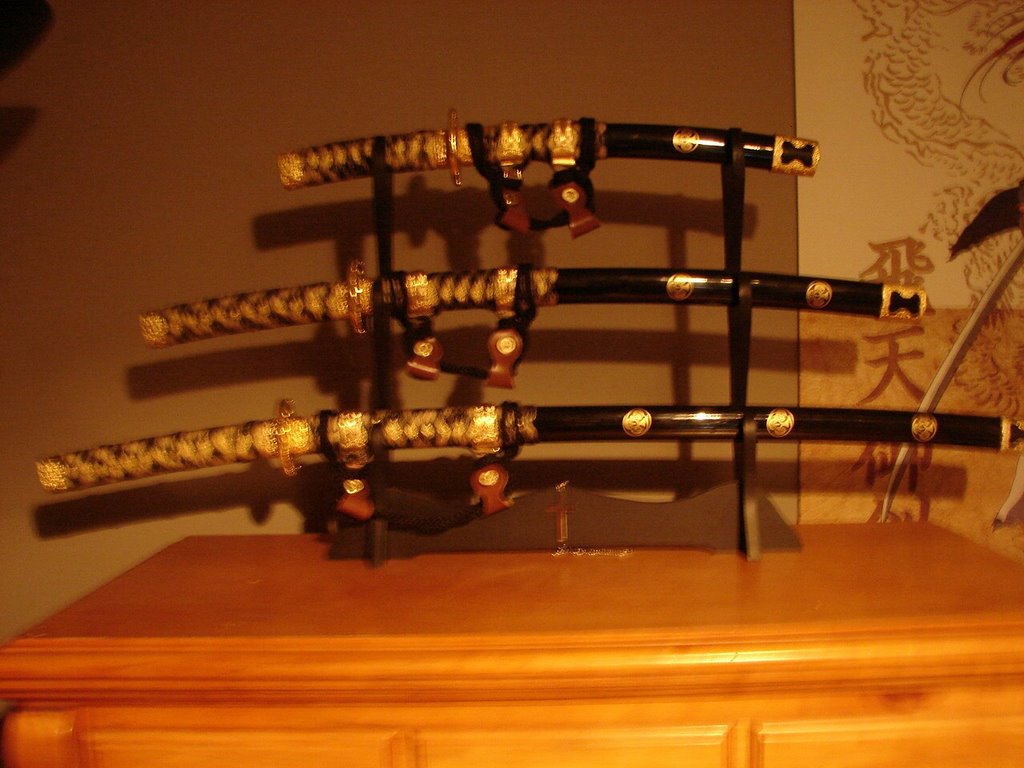
This is a nice gift I received from a very good friend of mine who is also a Japanime fan. To me, these symbolize our everlasting friendship and these Swords receive the highest honor in my [future] collection. What I like about them is, they are decorative pieces, and are not meant for actual cutting, thus the 440 Stainless Steel, which does NOT require cleaning. I think the swords absoloutly ROCK, and I wanted to post a picture of them so the gift giver knows what I have done with them.